
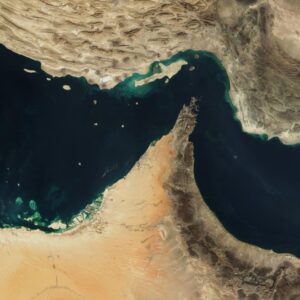
The Middle East has once again become the focal point of a rapidly escalating geopolitical crisis, one with immediate and far reaching consequences for global logistics. As of March 2026, a combination of military conflict, airspace shutdowns, maritime security threats, and structural shipping disruptions has brought unprecedented pressure onto supply chains worldwide.
Below, we break down the situation and its business implications, supported by the latest industry and government intelligence.
1. Strait of Hormuz Closure: A Critical Pressure Point
On February 28, 2026, Iranian retaliation following coordinated U.S.–Israeli strikes led the Islamic Revolutionary Guard Corps (IRGC) to declare the Strait of Hormuz closed to all commercial vessel traffic, halting one of the world’s most vital energy and shipping corridors. About 20% of global oil supply typically flows through Hormuz, making the closure one of the most significant maritime disruptions in decades.
As a result:
- Ocean carriers have suspended all transits through Hormuz, rerouting vessels or placing them on hold.
- Ports such as Jebel Ali and Doha have become inaccessible, resulting in severe congestion and schedule fragmentation.
- Leading carriers, including Maersk, have paused all vessel crossings in Hormuz and expect delays and rerouting across Gulf services.
For businesses in the supply chain, this means longer lead times, possible reallocation of routings, and increased operational variability for Gulf linked supply chains.
2. Suez Canal and Red Sea Instability: A Return to Cape of Good Hope Routing
Just as the industry began cautiously reintroducing limited services via the Red Sea and Suez Canal earlier in February 2026, renewed conflict forced carriers to reverse course.
A combination of military escalation and new targeted attacks has resulted in:
Complete suspension of Trans-Suez traffic
- Maersk, MSC, and CMA CGM have halted Suez transits and rerouted vessels around the Cape of Good Hope, citing untenable security conditions.
- The closure eliminates the strategic 10–15 day transit?time advantage that Suez normally provides.
Houthi missile and drone attacks intensifying
- New attacks on February 8, 2026, targeted vessels in the Bab el-Mandeb Strait, prompting carriers to again divert around Africa.
- With 12% of global trade usually passing through Bab el-Mandeb, diversions add two weeks to transit times and sharply raise fuel and insurance costs.
For importers and exporters using Asia–Europe or Middle East–Europe trade these developments mean:
- Higher freight rates due to extended routing
- Capacity tightening on already strained lanes
- Longer and more variable transit windows
3. Air Freight Complications: Restricted Airspace and Volatility
Widespread airspace closures have triggered international flight suspensions and diversions across Iran, Iraq, Israel, Qatar, Bahrain, Kuwait, and the UAE.
This has resulted in:
- Reduced global air cargo capacity, particularly on Asia–Europe and Asia–Middle East lanes
- Longer flight paths and increased fuel costs
- Rate volatility and war risk surcharges across many carriers
For urgent or time sensitive goods, air freight disruptions may challenge existing SLAs. Meachers continues to work closely with airline partners to secure capacity and provide alternatives.
4. Oil Market Ripple Effects: Rising Cost Pressures
With the conflict threatening oil flows through both Hormuz and the wider Gulf region:
- Analysts warn that prolonged closure could push oil prices above $100 per barrel, driving global inflationary pressure.
- Jet fuel surcharges and bunker adjustment factors (BAFs) are expected to climb as carriers respond to turbulence in fuel markets.
This has immediate implications for global transportation costs across all modes.
5. Operational Outlook: What Businesses Should Expect
Industry bodies stress that the current situation resembles a systemic multi corridor disruption, not an isolated chokepoint issue:
- The World Shipping Council reports widespread rerouting, extended voyage times, and global network instability.
- Carriers are invoking force majeure, suspending transit guarantees and revising service schedules.
- European ports may experience temporary congestion as vessels rerouted from Africa arrive in compressed windows.
6. What Meachers Global Logistics Is Doing
At Meachers, our teams are:
- Continuously monitoring maritime and airspace developments
We maintain active communication with carriers, port authorities, and global partners to anticipate changes in real time.
- Re-engineering routings for reliability
Where possible, we are shifting cargo to the most stable lanes, adjusting consolidation plans, and exploring multimodal solutions.
- Supporting customers with proactive planning
We advise shippers to prepare for:
- Extended lead times
- Higher freight costs driven by fuel, insurance, and capacity pressures
- Short notice schedule revisions across global networks
The March 2026 Middle East conflict represents one of the most severe logistics disruptions in recent years, affecting every major trade lane touching Asia, Europe, and the Gulf. While the situation is fluid and rapidly evolving, Meachers Global Logistics remains committed to guiding businesses through uncertainty with informed planning, operational flexibility, and dependable support.
If your supply chain is already being affected or you’d like to explore alternative options, our team is here to help.